

Safe, Ethical, and Human-Supervised Robotics
- View
Safe, Ethical, and Human-Supervised Robotics [20 minutes]
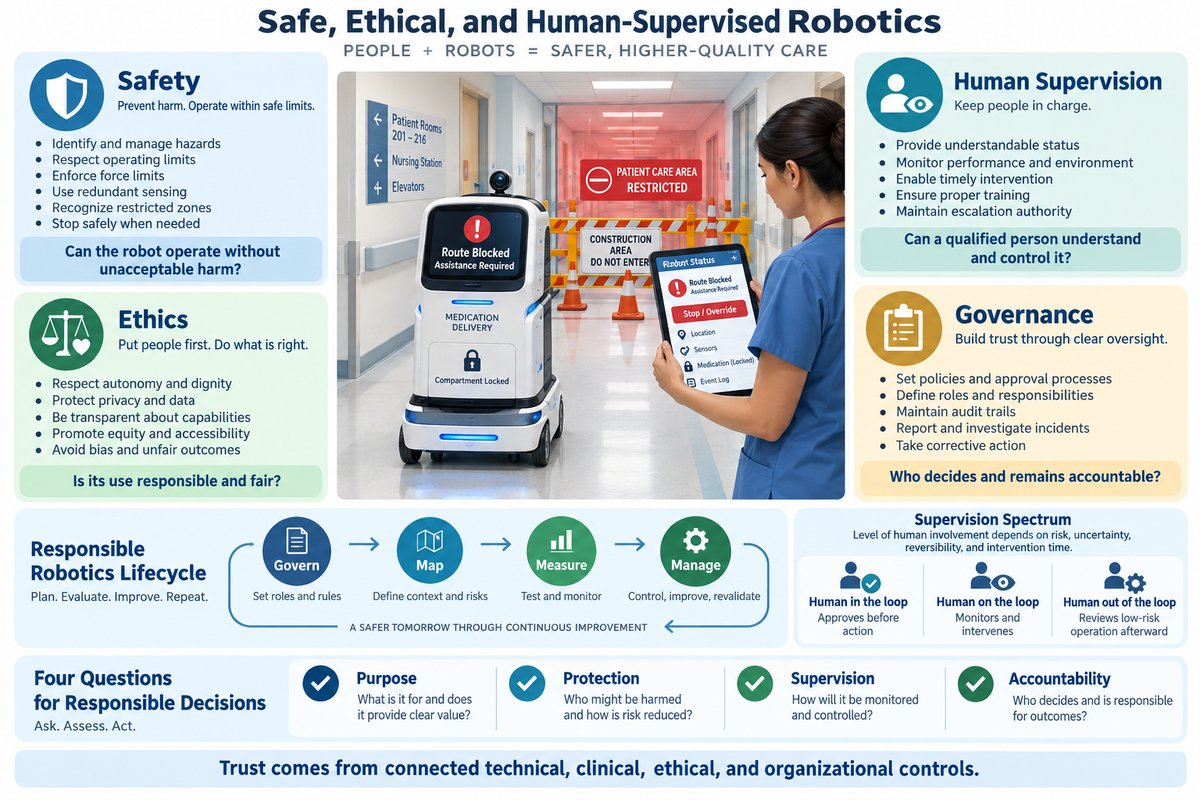
When a helpful robot creates a clinical risk
A hospital introduces a mobile robot that transports medications from the pharmacy to nursing units. The robot uses machine learning to navigate crowded hallways, recognize obstacles, and choose efficient routes. During a busy shift, construction barriers block its usual path, and the robot approaches a restricted patient-care area that was not represented in its training data.
The robot’s behavior raises questions that go beyond whether its navigation model is technically accurate. Who should stop it? What information does the supervising nurse need? Who is accountable if medication delivery is delayed or the robot enters an unsafe area? In healthcare, a robot operates inside a system of patients, clinicians, facilities, policies, and other technologies, so its safety depends on that entire system.
These questions matter as AI-enabled medical technologies become more common. As of September 2026, the US Food and Drug Administration reported that it had authorized more than 1,600 AI-enabled medical devices, while also emphasizing lifecycle safety and effectiveness. Robotic medical devices now support tasks such as surgery, rehabilitation, diagnosis, blood collection, and transportation, making responsible oversight increasingly important. (fda.gov)
Four ideas that define responsible robotics
Safety means reducing the probability and severity of harm to patients, staff, visitors, and the environment. It includes physical risks, such as collisions or excessive force, as well as clinical risks, such as incorrect treatment recommendations, delayed medication delivery, or missed alerts. A robot can function exactly as programmed and still be unsafe if its intended behavior does not match the clinical situation.
Ethics concerns what the system should do, whose interests it should protect, and how benefits and burdens are distributed. In healthcare robotics, ethical questions often involve patient autonomy, privacy, dignity, fairness, accessibility, and accountability. Ethics therefore shapes both the robot’s technical requirements and the policies governing its use.
Human supervision means that qualified people remain able to understand, monitor, question, interrupt, and take responsibility for the robot’s work. Supervision is not achieved merely by placing a person near a machine or adding an emergency-stop button. The human must have enough information, authority, time, and training to intervene effectively.
Governance is the collection of roles, rules, review processes, documentation, and accountability mechanisms surrounding the technology. Governance identifies who approves a robot, who monitors it, who receives incident reports, and who can suspend its use. It converts broad commitments such as “keep patients safe” into repeatable organizational action.
| Category | Safety | Ethics | Human supervision | Governance |
|---|---|---|---|---|
| Central question | Can the robot perform its task without unacceptable harm? | Is the robot being used in a responsible and fair way? | Can a qualified person understand and control its behavior? | Who makes decisions and remains accountable? |
| Primary focus | Hazards, failures, operating limits, and safeguards | Autonomy, dignity, privacy, equity, and public benefit | Monitoring, intervention, escalation, and clinical judgment | Policies, responsibilities, evidence, auditing, and incident response |
| Typical evidence | Test results, hazard analyses, failure logs, and validation data | Equity reviews, consent processes, stakeholder feedback, and privacy assessments | Training records, interface tests, override performance, and response times | Approval records, responsibility maps, audit trails, and review reports |
| Failure example | A rehabilitation robot applies excessive force | A care robot records a private conversation without appropriate safeguards | A clinician cannot determine why the robot stopped | Staff assume the vendor is responsible for every incident |
Safety begins with a defined job and operating boundary
A healthcare robot should have a clearly defined intended use: the task it is designed to perform, the people it serves, and the conditions under which it may operate. A medication-delivery robot, for example, might be approved to move sealed packages between specific hospital locations during staffed hours. That definition does not automatically authorize it to transport controlled substances, enter isolation areas, or operate during a fire alarm.
These boundaries form the robot’s operational design domain, or ODD. The ODD can include permitted locations, floor conditions, lighting levels, network availability, patient characteristics, staffing arrangements, and environmental constraints. When conditions move outside that domain, the safest action may be to slow down, stop, request help, or transfer control to a person rather than attempt to improvise.
Safety engineering then asks what could go wrong and how the system should respond. Developers and healthcare organizations examine hazards such as sensor failure, incorrect object recognition, loss of connectivity, unexpected human movement, or inaccurate AI predictions. They add layers of protection, including physical guards, force limits, redundant sensing, restricted zones, alarms, safe-stop behavior, and manual controls.
The goal is not to prove that failure is impossible. Complex systems can encounter unexpected combinations of events, particularly in dynamic clinical environments. The practical goal is to identify foreseeable hazards, reduce their likelihood or impact, detect emerging problems, and recover safely when normal operation cannot continue.
Best practices include defining measurable acceptance criteria, testing realistic edge cases, and verifying that safety controls remain effective when individual components fail. Teams should test the integrated human-robot system, not only the model or mechanical device in isolation. FDA guidance similarly emphasizes the performance of the human-AI team and the importance of providing users with clear, essential information. (fda.gov)
A common pitfall is automation bias, in which people accept an automated output because it appears precise or objective. Another is assuming that high average accuracy guarantees safety in every subgroup or environment. A system that performs well overall may still fail disproportionately for particular patients, room configurations, mobility aids, skin tones, speech patterns, or clinical conditions.
Ethics protects people, not just performance metrics
Ethical robotics begins by recognizing that patients are people with rights, preferences, vulnerabilities, and differing needs. A robot may produce an efficient outcome while still undermining dignity or autonomy. For example, using a social robot to encourage an older adult to take medication may appear beneficial, but the interaction becomes ethically questionable if the person cannot decline, does not understand that the robot is automated, or feels pressured by its behavior.
The World Health Organization identifies six principles for AI in health: protecting autonomy; promoting well-being, safety, and the public interest; ensuring transparency and intelligibility; fostering responsibility and accountability; ensuring inclusiveness and equity; and promoting responsive, sustainable AI. These principles apply to robots because an embodied AI system can directly affect patients, clinical decisions, and physical environments. (who.int)
Autonomy requires meaningful human choice. Depending on the robot and clinical context, this may involve informed consent, an understandable explanation, or a reasonable alternative for patients who do not want robotic involvement. Consent should not be treated as a one-time signature if the robot’s capabilities, data collection, or role changes substantially.
Equity requires teams to investigate who benefits, who faces additional risk, and who may be excluded. Training and evaluation data should represent the populations and conditions in which the system will operate. Yet representative data alone are insufficient; teams must also evaluate physical accessibility, language needs, workflow differences, and the consequences of errors for different groups.
Privacy is equally important because robots may collect video, audio, location data, biometrics, or clinical information. In the United States, the HIPAA Privacy Rule establishes protections for individually identifiable health information held by covered entities and requires appropriate safeguards and limits on unauthorized uses and disclosures. A responsible deployment therefore collects only necessary data, restricts access, defines retention periods, and informs patients about relevant data practices. (hhs.gov)
A typical misconception is that ethical review is subjective and therefore separate from engineering. In practice, ethical priorities become technical and operational requirements. A commitment to privacy can produce requirements for local processing, access controls, deletion schedules, and disabled microphones in certain spaces, while a commitment to autonomy can require consent prompts and a nonrobotic care option.
Human oversight must be active and effective
Human supervision can take several forms depending on the risk and speed of the task. In a human-in-the-loop arrangement, the robot must receive human approval before completing a consequential action. In a human-on-the-loop arrangement, the robot acts within defined limits while a person monitors it and can intervene. A human-out-of-the-loop system acts without real-time human control, although people may still establish policies and review performance afterward.
| Category | Human in the loop | Human on the loop | Human out of the loop |
|---|---|---|---|
| Human role | Reviews or authorizes a specific action before execution | Monitors autonomous activity and intervenes when needed | Sets boundaries and reviews the system outside real-time operation |
| Appropriate use | High-consequence or uncertain clinical decisions | Bounded tasks with detectable failures and sufficient intervention time | Low-risk, reversible tasks with strong controls |
| Example | A surgeon authorizes a robot-assisted action | A technician monitors an autonomous hospital transport robot | A robot automatically records supply counts overnight |
| Main limitation | Approval can become rushed or routine | One person may be asked to supervise too many systems | Harm may occur before a person knows intervention is needed |
The correct level of supervision depends on risk, uncertainty, reversibility, and time to intervene. A robot recommending a rehabilitation exercise may permit clinician review before the plan reaches the patient. A surgical robot, however, operates in a setting where milliseconds, force limits, and immediate control transfer can matter, so supervision must be designed around the realities of the procedure.
Effective oversight requires meaningful human control. The supervisor must understand the robot’s current state, recognize abnormal behavior, know the system’s limits, and possess the authority to stop or override it. The interface should communicate uncertainty, warnings, and control status without overwhelming the user with unnecessary alerts.
Training is part of the control system rather than an administrative extra. Staff need role-specific instruction covering normal use, prohibited use, warning interpretation, manual operation, emergency procedures, and incident reporting. Periodic simulations can confirm that staff can intervene under realistic time pressure instead of merely passing a written knowledge check.
A serious pitfall is the moral crumple zone, in which an organization assigns blame to the nearest human operator even though that person lacked useful information or realistic control. Responsibility should reflect actual authority and system design. Developers, vendors, clinical leaders, IT teams, risk managers, operators, and executives may each hold different parts of the responsibility.
Trustworthy operation requires lifecycle management
Approval or purchase is not the end of safety work. A robot can perform differently after deployment because its environment, users, hardware, software, patient population, or connected systems change. NIST’s AI Risk Management Framework addresses risk across design, development, deployment, use, and evaluation, and organizes risk management around the functions Govern, Map, Measure, and Manage. (nist.gov)
Govern establishes responsibilities, policies, documentation, and risk tolerance. Map identifies the use context, affected stakeholders, dependencies, and possible consequences. Measure evaluates performance, safety, fairness, privacy, security, and human interaction, while Manage prioritizes risks and implements responses.
Healthcare organizations can turn these functions into a repeating lifecycle. Before deployment, they document the intended use, validate the robot locally, and prepare staff and infrastructure. During use, they monitor performance indicators and incidents; after changes or failures, they investigate causes, apply controls, and determine whether revalidation is necessary.
[[flowchart-placeholder]]
Monitoring should include more than mechanical breakdowns. Teams may track override frequency, navigation failures, false alarms, task completion, near misses, subgroup performance, cybersecurity events, and cases in which staff work around the robot. A sudden increase in manual overrides may reveal environmental change, confusing interface behavior, or model drift before a serious injury occurs.
A common misconception is that a machine-learning system inevitably learns safely from every new experience. Some systems remain fixed after deployment, while others can change only through controlled updates. When an update can affect safety or effectiveness, it needs documented evaluation, approval, communication, and monitoring rather than an informal assumption that newer means better.
Example: supervising a rehabilitation robot
A stroke rehabilitation unit uses a robotic device to guide repetitive arm movements. Before treatment, a therapist selects a protocol, confirms the patient’s identity and clinical status, and establishes limits for force and range of motion. The robot then assists the movement while measuring resistance and adjusting support within those approved limits.
During one session, the patient experiences sudden shoulder pain and resists the movement. The robot detects increased resistance, stops motion, and alerts the therapist rather than trying to complete the programmed repetition. The therapist examines the patient, documents the event, modifies the treatment plan, and determines whether the session can continue.
This workflow combines several protections. Force and motion limits reduce physical risk, while the safe-stop behavior provides a technical safeguard. Human-in-the-loop protocol selection preserves clinical judgment, and real-time monitoring allows the therapist to recognize information that the robot cannot fully interpret, such as facial expression, fear, or a new symptom.
The robot may improve consistency and generate useful movement data, but it does not replace clinical assessment. Its measurements may be affected by sensor placement, unusual muscle tone, or changes in the patient’s condition. The organization must therefore maintain the device, review incidents and near misses, protect rehabilitation data, and reassess performance after software updates.
Example: governing an autonomous medication-delivery robot
Consider the mobile delivery robot approaching the restricted area. Its approved operating boundary allows travel only through mapped public corridors and designated service elevators. When construction blocks its planned route, the navigation system should not freely explore patient rooms in search of an alternative.
Instead, the robot enters a safe state, secures its medication compartment, and requests remote assistance. A pharmacy technician verifies the robot’s identity and cargo, while hospital operations confirms whether an approved alternate route exists. If no validated route is available, a staff member completes the delivery and records the robot’s inability to finish the task.
The event then enters the hospital’s incident-management process. The robotics team reviews maps, sensor logs, warning messages, and the operator’s actions, while pharmacy leadership examines medication security and delivery delay. Facilities personnel contribute information about the construction change, demonstrating that the cause belongs to the broader work system rather than solely to the robot or technician.
The hospital may update the map, strengthen construction-notification procedures, or create a geofenced restriction that blocks entry into sensitive areas. Before returning the robot to normal service, the team tests the change under realistic conditions and confirms that staff understand the revised escalation process. The result is not simply a repaired machine but a safer organizational workflow.
A practical standard for responsible decisions
Safe and ethical healthcare robotics depends on a chain of connected controls. The robot needs a defined purpose, validated operating boundary, reliable safeguards, and understandable outputs. The surrounding organization needs trained people, explicit authority, privacy protections, incident processes, and continuous monitoring.
When evaluating a robotic system, decision-makers should ask four questions:
-
Purpose: Is the robot’s clinical or operational task specific, justified, and appropriately limited?
-
Protection: What prevents, detects, and reduces physical, clinical, privacy, and equity-related harm?
-
Supervision: Can qualified people understand the robot, intervene in time, and escalate concerns?
-
Accountability: Are responsibilities, records, review processes, and corrective actions clearly assigned?
No single control provides complete protection. An emergency stop cannot correct biased data, informed consent cannot compensate for unsafe motion, and human supervision cannot work if the operator receives unclear information. Responsible robotics emerges when technical, ethical, clinical, and organizational protections reinforce one another.
Robotics that earns trust
-
Safety starts with boundaries: A robot needs a well-defined task, operating domain, tested safeguards, and safe behavior outside normal conditions.
-
Ethics becomes system design: Autonomy, dignity, privacy, transparency, and equity must appear in requirements, interfaces, policies, and workflows.
-
Human supervision must be meaningful: Supervisors need useful information, sufficient time, appropriate training, and genuine authority to intervene.
-
Responsibility continues after deployment: Monitoring, incident review, controlled updates, and revalidation keep the human-robot system dependable over time.
Healthcare robots can extend human capability, improve consistency, and support demanding clinical workflows. They earn trust, however, only when people remain protected, informed, empowered, and accountable throughout the technology’s lifecycle.
Web Sources
-
World Health Organization, Ethics and Governance of Artificial Intelligence for Health. (who.int)
-
US Food and Drug Administration, Artificial Intelligence-Enabled Medical Devices. (fda.gov)
-
US Food and Drug Administration, Robotic Medical Devices. (fda.gov)
-
US Food and Drug Administration, Transparency for Machine Learning-Enabled Medical Devices: Guiding Principles. (fda.gov)
-
National Institute of Standards and Technology, AI Risk Management Framework. (nist.gov)
-
US Department of Health and Human Services, The HIPAA Privacy Rule. (hhs.gov)