

Machine Learning and AI in Robotic Healthcare Tasks
- View
Machine Learning and AI in Robotic Healthcare Tasks [20 minutes]
When a robot must interpret, not just move
A rehabilitation robot supports a patient recovering from a stroke. The machine can move the patient’s arm along a fixed path, but useful therapy requires more than repeating the same motion. It must detect resistance, estimate whether the patient is contributing to the movement, and adjust assistance without applying unsafe force.
Traditional software can handle predictable situations through predefined rules. Healthcare, however, involves changing anatomy, incomplete sensor readings, different patient responses, and unexpected events. Machine learning and artificial intelligence help robotic systems interpret these complex conditions and adapt their behavior to a specific task.
This distinction matters because a robot’s physical precision does not automatically make it intelligent. A mechanical arm may position an instrument with great accuracy while relying entirely on a clinician’s commands. Conversely, an AI model may recognize an anatomical structure in an image without controlling any physical device. Intelligent healthcare robotics emerges when sensing, computation, and controlled physical action work together.
How robotics, AI, and machine learning differ
Robotics focuses on machines that sense or act in the physical world. A healthcare robot may move an instrument, support a limb, transport supplies, position an imaging sensor, or assist with a clinical procedure. Its hardware usually includes sensors, processors, actuators, mechanical structures, and interfaces for human operators.
Artificial intelligence, or AI, is the broader field of creating systems that perform tasks associated with human intelligence. These tasks include perception, reasoning, planning, prediction, language processing, and decision support. AI does not require a physical robot; it can operate entirely as software.
Machine learning, or ML, is a major approach within AI. Instead of programming every decision as an explicit rule, developers use data to train a model to recognize useful patterns. The trained model can then make predictions or classifications when it receives new data.
| Category | Robotics | Artificial intelligence | Machine learning |
|---|---|---|---|
| Primary focus | Interacting with the physical world through sensing and movement | Performing tasks involving perception, reasoning, planning, or decision-making | Learning patterns from data to generate predictions or classifications |
| Healthcare example | A powered device moves a patient’s arm during rehabilitation | A system determines how assistance should change during the movement | A model estimates the patient’s effort from force and motion data |
| Key output | Physical action or controlled movement | An interpretation, plan, recommendation, or action | A probability, predicted value, category, or learned control signal |
| Can operate alone? | Some robots can perform fixed motions without AI | AI can function without a physical robot | ML can be used in software that has no robotic component |
| Main limitation | Accurate motion does not guarantee correct clinical behavior | AI depends on its design, data, context, and intended use | A model may fail when new data differs from its training data |
The relationship can be understood through a simple analogy. The robot is the body, sensors act like the senses, and AI provides part of the information-processing capability. Machine learning is one way that capability can be developed, but it is not the only way. An intelligent robot may combine learned models with conventional control equations, safety limits, and clinician-defined rules.
A common misconception is that every healthcare robot learns continuously from each patient. In reality, many systems use models that were trained and validated before deployment. They may adapt certain settings during use, but uncontrolled learning in a clinical environment could change performance in unpredictable ways.
From patient data to controlled action
An AI-enabled robotic task usually follows a repeating sequence: sense, interpret, decide, act, and monitor. The exact implementation differs across applications, but this loop provides a useful way to understand how intelligence connects to physical behavior. If any stage produces unreliable information, the error can affect the stages that follow.
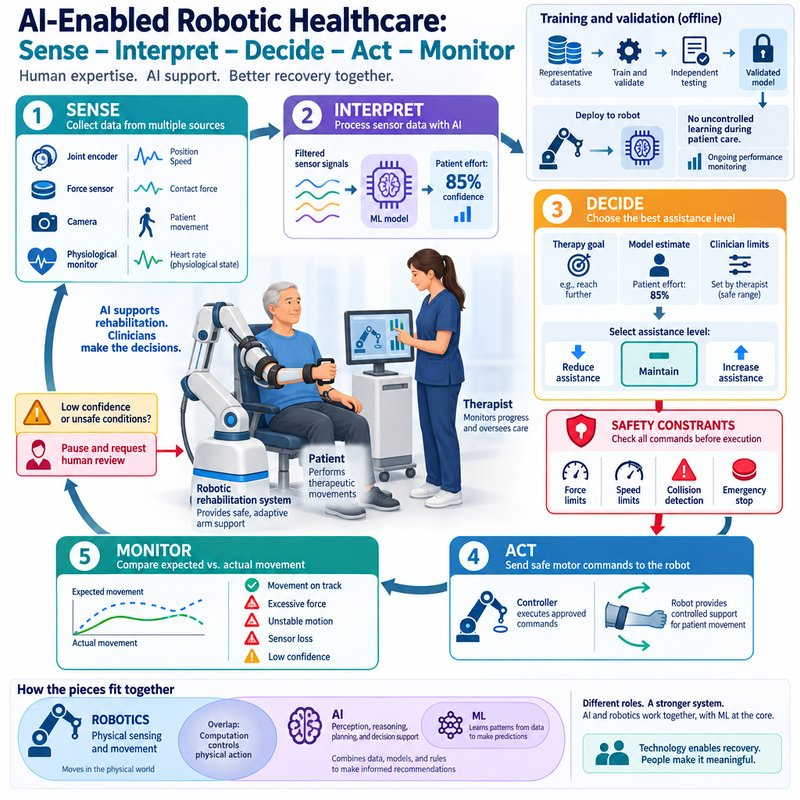
During sensing, the robot collects information through cameras, force sensors, encoders, microphones, imaging devices, or physiological monitors. An encoder may report the angle of a joint, while a force sensor measures contact between the robot and the patient. These raw readings are not automatically meaningful; they require calibration, filtering, synchronization, and interpretation.
During interpretation, software converts sensor data into an estimate of the current situation. A vision model might identify an instrument or anatomical landmark, while another model estimates whether a patient’s movement is intentional. The output often includes uncertainty, such as an 85% probability that a structure belongs to a particular category.
The system then uses that interpretation to decide and act. A planner selects a target, route, or adjustment, while a controller translates that decision into precise motor commands. Monitoring continues throughout the action so that the robot can detect excessive force, unexpected movement, sensor loss, or disagreement between its expected and actual state.
[[flowchart-placeholder]]
A well-designed system does not treat the ML model as the only source of truth. It surrounds the model with operational boundaries such as speed limits, force thresholds, collision detection, emergency stops, and rules for requesting human intervention. This layered design matters because a prediction can be statistically reasonable while still being inappropriate for a particular patient or clinical moment.
Perception: helping robots understand clinical surroundings
Machine perception is the use of sensor data to estimate what is happening around or within a robot. Healthcare robots may need to recognize anatomy, track instruments, measure patient posture, identify obstacles, or determine whether a target is moving. Perception converts complex signals into information that the robot or clinician can use.
Computer vision is a common form of machine perception. A model can be trained with labeled images in which relevant structures have been identified by qualified annotators. It then learns visual patterns associated with those structures and produces outputs such as a class label, a bounding box, a segmented region, or a set of tracked coordinates.
Perception becomes difficult when clinical conditions differ from the training environment. Lighting, camera angle, blood or fluid, patient anatomy, equipment placement, sensor noise, and partial obstruction can all change what the model receives. A model that performs well on clean development data may be less reliable when an instrument blocks part of the image or when a sensor is positioned differently.
Good practice therefore includes testing across representative patients, devices, operators, and clinical conditions. Developers also examine false positives, false negatives, and performance across relevant subgroups rather than relying on one overall accuracy value. FDA materials emphasize that narrow or unrepresentative training data can give an AI-enabled device a limited view of the patient population it is expected to serve. (fda.gov)
-
Best practice: Define exactly what the model must recognize and under which operating conditions.
-
Common pitfall: Treating a high laboratory accuracy score as proof of reliable clinical performance.
-
Typical misconception: Assuming the model sees and understands an image in the same way a clinician does.
-
Practical safeguard: Detect low-quality input and pause, warn the operator, or switch to a safer mode.
Prediction and planning: choosing a useful response
After interpreting the environment, an AI-enabled robot may need to predict what will happen next or determine an appropriate response. A rehabilitation system might estimate whether a patient can complete a movement. A positioning robot might predict the path of a moving anatomical target, while a transport robot might select a route that avoids people and equipment.
Predictions do not directly become safe actions. They first pass through a planning layer that considers goals, constraints, and available actions. For example, a model may predict that a patient needs more assistance, but the controller must still determine how much additional force to apply, how quickly to apply it, and when to stop.
Planning can combine ML with conventional methods. A learned model might estimate tissue location, while a rule-based component prohibits movement beyond a defined boundary. Mathematical controllers can maintain stable motion, while clinician-selected settings determine the therapeutic target. This hybrid approach uses ML where patterns are difficult to specify manually and established engineering methods where predictable behavior is essential.
The major danger is automation bias, which occurs when people give excessive weight to a system’s output because it appears objective or technically sophisticated. An AI prediction is based on relationships in data, not a complete understanding of the patient. Good interfaces therefore communicate confidence, operating limits, and reasons for alerts in ways that help clinicians make informed decisions rather than simply accept a recommendation.
-
Best practice: Separate prediction from final action so constraints can be applied between them.
-
Common pitfall: Allowing one uncertain output to trigger a high-impact movement without confirmation.
-
Typical misconception: Believing that the highest-probability prediction is always clinically correct.
-
Practical safeguard: Define conditions under which the robot slows, stops, or transfers control.
Learning from data without learning the wrong lesson
Machine learning begins with a clearly defined task and a dataset that represents relevant conditions. During training, an algorithm adjusts internal parameters to reduce errors on examples. Developers then use separate validation and test data to evaluate how well the resulting model handles cases it did not use for training.
The separation between datasets is important. If a model is tested on examples it has already seen, it may appear highly accurate because it has memorized details rather than learned patterns that generalize. This problem is called overfitting. In healthcare, overfitting can be especially difficult to detect when images or measurements from the same patient appear in both training and testing data.
Data quality includes more than the number of examples. Developers must consider whether labels are clinically meaningful, sensors were calibrated consistently, rare but important cases are represented, and the population reflects intended users. Missing data can also carry misleading patterns; a model might learn differences between hospitals, devices, or documentation practices instead of the clinical feature developers intended.
Evaluation continues after deployment because real clinical environments can change. New equipment, updated workflows, different patient populations, or altered sensor configurations may cause data drift, meaning current inputs no longer match the conditions used for development. The FDA treats AI-enabled medical devices through applicable premarket pathways and may review software modifications that could significantly affect safety or effectiveness. (fda.gov)
| Stage | Purpose | Healthcare robotics concern |
|---|---|---|
| Data collection | Gather examples of relevant inputs and outcomes | Data must represent intended patients, operators, sensors, and environments |
| Training | Adjust the model to learn patterns | The model can learn accidental shortcuts or biases in the dataset |
| Validation | Select settings and compare model versions | Repeated tuning can make results overly specific to the validation set |
| Testing | Estimate performance on unseen cases | Test cases must remain independent and reflect realistic clinical use |
| Deployment monitoring | Detect changes and unexpected behavior | Device, workflow, or population changes may reduce performance over time |
The NIST AI Risk Management Framework describes AI risk management as an ongoing activity across design, development, deployment, use, and evaluation. Its core functions—Govern, Map, Measure, and Manage—reinforce that model performance is only one part of a trustworthy system. Organizations must also define responsibilities, understand the context of use, measure relevant risks, and respond when performance falls outside acceptable limits. (nist.gov)
Assistance is not the same as autonomy
The word autonomous is often used too broadly. A robot may automate one narrow function while remaining under direct human control for the overall procedure. Understanding what the system controls—and what the clinician still controls—is more useful than applying a single label to the entire device.
| Operating approach | Robot’s role | Human role | Example |
|---|---|---|---|
| Direct control | Reproduces the operator’s commands | Initiates and controls each movement | A surgeon moves instruments through a console |
| Task assistance | Stabilizes, filters, aligns, or recommends | Selects the goal and supervises execution | Software highlights a target or reduces hand tremor |
| Conditional automation | Performs a defined subtask within limits | Approves the task and intervenes when needed | A robot follows a planned path while monitoring boundaries |
| Higher autonomy | Selects and performs more actions independently | Sets goals and oversees exceptions | An experimental system adapts a task from sensor feedback |
Robotically assisted surgery illustrates why precise terminology matters. FDA guidance explains that currently used robotically assisted surgical systems operate under direct human control; the surgeon uses computer and software technology to move the instruments. The device may improve visualization and dexterity, but it is not independently performing the operation. (fda.gov)
Autonomy is also task-specific rather than all-or-nothing. A robot may independently maintain camera alignment but require human approval before repositioning an instrument. Another system may calculate an optimal trajectory while leaving execution to a trained clinician. Each automated function needs its own boundaries, performance evidence, fallback behavior, and method for human intervention.
A typical misconception is that greater autonomy always produces greater clinical value. In practice, the appropriate level depends on task complexity, potential harm, environmental uncertainty, and the ability to recognize failure. Sometimes the most useful AI function is a modest one that reduces workload while keeping a clinician firmly in control.
Example: adaptive robotic stroke rehabilitation
Consider a patient using a robotic arm support after a stroke. The clinical goal is not simply to move the arm from one point to another. The system should encourage active participation while providing enough assistance for the patient to complete a meaningful therapeutic movement.
First, joint encoders measure position and speed, while force or torque sensors measure how the patient interacts with the device. The software filters these signals and estimates features such as movement smoothness, direction, completion time, and the patient’s contribution. An ML model may use those features to estimate whether the current level of assistance is too high, too low, or appropriate.
Next, the planner selects an adjustment within limits established by the therapy program. If the patient contributes more effort, the robot may gradually reduce assistance. If movement becomes unstable or resistance exceeds a threshold, the system can slow down, stop, or ask the therapist to review the situation rather than automatically increasing force.
The benefit is responsive, repeatable support that can help therapists deliver many carefully controlled movements. The system can also record consistent measurements across sessions, allowing clinicians to observe patterns in performance. However, the model cannot independently determine the complete cause of poor movement; fatigue, pain, confusion, spasticity, sensor displacement, and lack of motivation may produce similar data.
The robotic system therefore operates as part of a broader rehabilitation workflow. The therapist chooses suitable activities, evaluates clinical changes, checks the device setup, and interprets the recorded results. AI supports this work by adapting a narrow aspect of the task, not by replacing clinical judgment.
Example: AI-assisted robotic ultrasound positioning
Ultrasound quality depends heavily on probe position, angle, contact pressure, and operator skill. A robotic positioning system can hold and move the probe, while AI analyzes incoming images to determine whether the view matches a target anatomical region. This combination may support more consistent image acquisition in a defined examination.
The process begins with the clinician selecting the examination goal and positioning the patient. Cameras, force sensors, and the ultrasound stream provide data about probe location, contact, and image content. A perception model evaluates whether required structures are visible, while a controller makes small adjustments to probe angle or position within approved limits.
The system continuously compares expected and observed results. If image quality improves, it can maintain or refine the position. If contact force becomes excessive, tracking is lost, or confidence falls below a threshold, the robot should stop or return control to the operator rather than continue searching without reliable information.
This approach can reduce physical strain and support repeatable positioning, but it has important limitations. Anatomical variation, patient movement, wounds, implanted devices, and unusual findings can create conditions outside the model’s experience. A technically acceptable image also may not answer the clinician’s diagnostic question, so qualified interpretation remains essential.
The example shows how healthcare robotics connects with organizational processes. Staff need procedures for patient selection, setup verification, cleaning, maintenance, incident reporting, and review of uncertain results. The FDA identifies diagnosis, surgery, rehabilitation, robotic blood draw, and endovascular tasks among the settings in which robotic medical devices may assist or perform healthcare activities, while emphasizing safety and effectiveness requirements. (fda.gov)
What reliable AI-enabled robotics requires
AI does not transform a healthcare robot into an all-purpose clinical expert. It gives the system a defined capability, such as recognizing an object, estimating a state, predicting an outcome, or adjusting a task. That capability remains limited by its data, sensors, design assumptions, operating environment, and connection to the rest of the robotic system.
The most important principles are straightforward:
-
Robotics provides physical interaction, while AI provides selected perception, prediction, planning, or decision capabilities.
-
Machine learning learns patterns from data, so representative data and independent testing are essential.
-
Predictions must pass through constraints before they become physical actions.
-
Autonomy is task-specific, and many clinical robots remain directly or conditionally controlled by people.
-
Performance must be monitored over time because patients, devices, environments, and workflows can change.
Healthcare robotics works best when intelligence is applied to a well-defined task and supported by careful engineering. The central question is not whether a robot “has AI,” but whether its AI function is suitable, reliable, and useful for the specific clinical context. WHO guidance similarly emphasizes well-defined uses, safety, transparency, accountability, human autonomy, and continuing assessment when AI is applied in health. (who.int)
Next, we'll build on this by exploring Safe, Ethical, and Human-Supervised Robotics.