

Data Collection Methods and Tools
- View
Understanding Data Collection in RCTs
Real-World Education Challenges
Imagine you're an educational researcher preparing to conduct a randomized controlled trial (RCT) to assess the effectiveness of a new mathematics curriculum. Your goal is to determine if this curriculum significantly improves student outcomes. At this critical juncture, the effectiveness of your RCT hinges on the data collection methods you choose. Collecting the right type of data using appropriate tools can make or break the success of your study, as it forms the backbone of your analysis and conclusions. Ensuring accuracy and reliability in data collection is paramount for any educational research aiming to influence policy or classroom practices.
The Fundamentals of Data Collection in RCTs
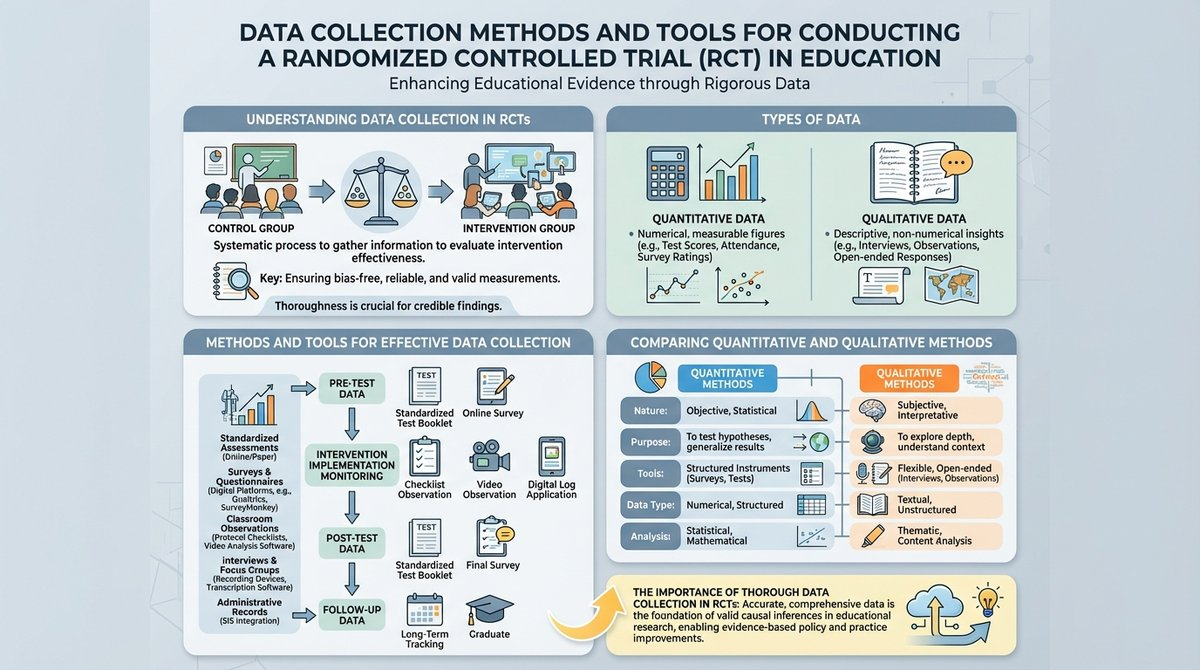
Data Collection in RCTs: At its core, data collection in RCTs involves systematically gathering and measuring information on variables of interest. This process is crucial for evaluating the outcomes of interventions in an unbiased manner. In the context of educational RCTs, data collection might include pre-test and post-test scores, attendance records, and qualitative feedback from educators.
Types of Data:
-
Quantitative Data: Often in the form of numerical scores that measure variables such as test results or attendance percentages.
-
Qualitative Data: Descriptive data that might include interviews, focus group discussions, and observational notes.
Key Principles:
-
Reliability: The consistency of a measure. A reliable tool yields the same results under consistent conditions.
-
Validity: The accuracy of a measure in capturing what it's intended to assess.
Methods and Tools for Effective Data Collection
Best Practices in Choosing Data Collection Methods
- Identify Objectives Clearly:
Understand what you need to measure. Are you interested in cognitive improvements, behavioral changes, or attitudes toward learning? - Select Appropriate Tools:
Choose tools that best capture the variables of interest. For quantitative data, this could include standardized tests or surveys. For qualitative data, consider interviews or open-ended questionnaires. - Ensure High-Quality Data:
Train data collectors thoroughly to reduce bias and enhance reliability.
Pilot-test your tools to identify and correct potential issues in data collection procedures.
Common Pitfalls and Misconceptions
-
Pitfall: Overlooking Contextual Factors. Assuming data collection methods are one-size-fits-all without considering cultural or contextual variations can lead to skewed data.
-
Misconception: Higher Quantitative Scores Signify Better Outcomes. This isn't always the case; understanding why scores change is crucial.
Comparing Quantitative and Qualitative Methods
| Aspect | Quantitative Methods | Qualitative Methods |
|---|---|---|
| Nature | Structured, numerical, objective | Unstructured, descriptive, subjective |
| Purpose | Measure variables, test hypotheses | Explore phenomena, understand context |
| Tools | Surveys, tests, questionnaires | Interviews, observations, open-ended surveys |
| Data Type | Numerical (scores, frequencies) | Textual (notes, transcripts) |
| Analysis | Statistical | Thematic, content analysis |
Applied Examples in Education
Example 1: Evaluating a Reading Intervention
Suppose you're examining the impact of a new reading program for third graders. You select standardized reading comprehension tests to quantify improvements and conduct interviews with teachers to gain insights into student engagement.
-
Process: Administer pre-tests and post-tests to measure reading levels before and after the intervention. Conduct structured interviews at regular intervals.
-
Outcome: Quantitative data reveal statistical improvements in comprehension scores, while qualitative data provide context—teachers report increased enthusiasm and participation in reading activities.
Example 2: Assessing a Teacher Training Program
You are tasked with evaluating how a teacher training program affects teaching practices. You choose to use classroom observations alongside teacher surveys to gather data.
-
Process: Conduct classroom observations using a standardized rubric to assess changes in teaching practices. Distribute surveys to capture teacher perceptions of the training's effectiveness.
-
Outcome: Observations indicate practical changes in teaching methodologies, while surveys reflect enhanced teacher confidence and willingness to implement new techniques.
The Importance of Thorough Data Collection
Your journey in understanding data collection methods involves discerning the subtle yet profound nuances in the tools and techniques employed. Data collection is not merely about gathering information—it is about gathering meaningful, accurate, and contextually relevant data that informs educational practice and policy.
Unpacking What's Next
This sets you up perfectly for Monitoring and Managing an RCT in Progress.